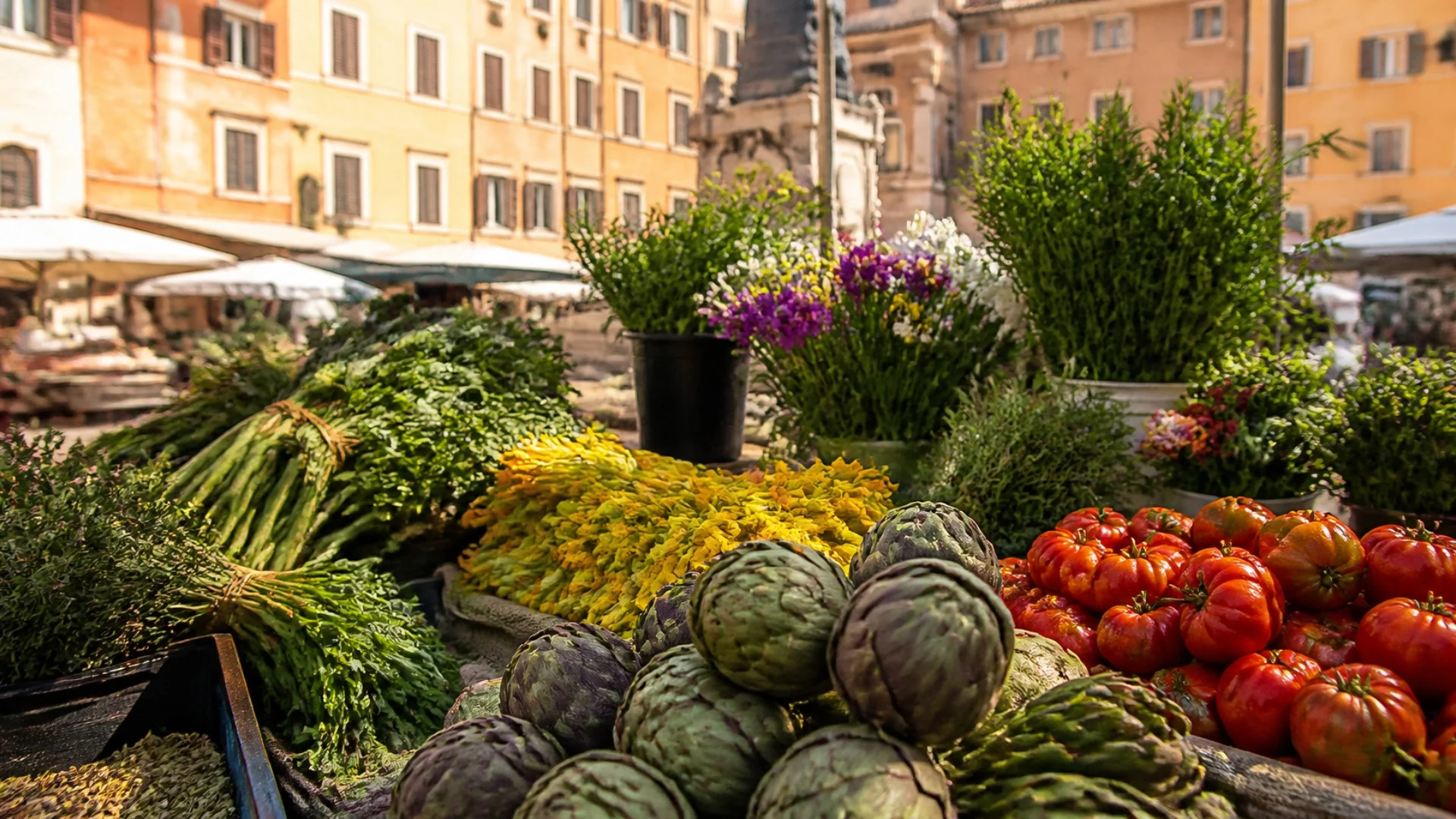
Campo de' Fiori is one of the most loved squares in Rome, and one of the few that has never stopped being part of everyday life. There are no grand churches facing it and no famous fountain at its centre; instead there is a market, a statue with a dramatic story, and a constant flow of Romans and visitors from early morning until late at night. We are lucky enough to cook on this square every day, so here is our short guide to what makes it special.
Why it is called the "field of flowers"
The name Campo de' Fiori means "field of flowers". In the Middle Ages this part of the city was not a square at all but an open meadow, where flowers grew among the ruins of ancient Rome. It became a real piazza in the fifteenth century, when the popes reshaped this district, and soon it was one of the busiest places in the city: inns, merchants, horse dealers and travellers on their way to St Peter's all passed through. Many of the surrounding streets still carry the names of the trades that once filled them, such as Via dei Cappellari (the hatters) and Via dei Baullari (the trunk makers).
The market
The square's best-known tradition is its open-air market, held here since the nineteenth century. Every morning except Sunday the stalls fill Campo de' Fiori with seasonal fruit and vegetables, flowers, herbs, spices, dried pasta and the colourful bottles of limoncello that visitors love to take home. It is at its liveliest in the early and mid morning; by the early afternoon the stalls are packed away and the square changes character again. Walking through the market is the easiest way to see what is in season in Rome: artichokes in winter and spring, cherries and courgette flowers in early summer, porcini mushrooms and chestnuts in autumn.
Giordano Bruno: the hooded statue
In the centre of the square stands the dark bronze figure of a hooded monk. He is Giordano Bruno, the philosopher and former Dominican friar who was condemned for heresy and burned alive on this spot on 17 February 1600. Bruno had argued, among other things, that the universe was infinite and that the stars were other suns with their own worlds. Centuries later, in 1889, the sculptor Ettore Ferrari created the statue that still stands here as a symbol of freedom of thought. Every year on the anniversary of his death, people still leave flowers at its base.
The fountain and the ancient theatre beneath your feet
At one end of the square stands a fountain known as la Terrina, "the soup tureen", for its rounded lid; the one you see is a copy, and the original stands today near the Chiesa Nuova. Even older history is hidden just behind the buildings on the east side. The great Theatre of Pompey, built in the first century BC and one of the largest in ancient Rome, once stood here, and its curved shape survives in the street plan: walk along Via di Grotta Pinta and you are following the line of the old seating. The theatre complex also included the hall where Julius Caesar was killed on the Ides of March in 44 BC, at what is now Largo di Torre Argentina, a few minutes' walk away.
Campo de' Fiori by day and by night
The square has two personalities. By day it belongs to the market, to shoppers and to visitors stopping for lunch between Piazza Navona and the river. When the stalls close, the cafés and restaurants spread their tables, and in the evening Campo de' Fiori becomes one of the city's favourite places for a drink and dinner outdoors, popular with Romans, students and travellers alike. It is a good place to sit, watch the city go by and decide where the evening will take you next.
What to see within a few minutes' walk
- Piazza Farnese, right next door, with its twin granite fountains and the Renaissance Palazzo Farnese.
- Piazza Navona, about five minutes north, with Bernini's Fountain of the Four Rivers.
- Palazzo Spada, home of Borromini's famous forced-perspective gallery.
- Via Giulia, one of Rome's most elegant Renaissance streets, running along the Tiber.
- The Jewish Ghetto and the Portico d'Ottavia, a short walk east.
- Ponte Sisto, the footbridge that takes you across the river into Trastevere.
Want to see it all in one day? Follow our walking route around Campo de' Fiori, from the market to Trastevere and Piazza Navona.
Eat on the square
After a morning at the market or an afternoon of sightseeing, there is no better way to enjoy Campo de' Fiori than at a table on the square itself. Osteria Tavola Magna is at Campo de' Fiori 34/36, open every day from 9:00 until 2:00, with a menu of Roman classics, handmade pasta, fish and pizza. See the menu or book your table, and make the "field of flowers" part of your Roman story.